Codenamed Uranverin or “Uranium Club”, the secret Nazi project to develop the atomic bomb began when fission (breaking of atomic nuclei), a basic process of making nuclear weapons, was first discovered in December 1938 by German scientists Otto Hahn and Fritz Strassmann. With sufficient materials, resources, a strong industrial base, and German military backing, the project was initiated in April 1939. This led to a nuclear arms race as the United States, warned about the German program through a letter by Jewish theoretical physicist, Albert Einstein, was determined to be the first to develop the bomb.
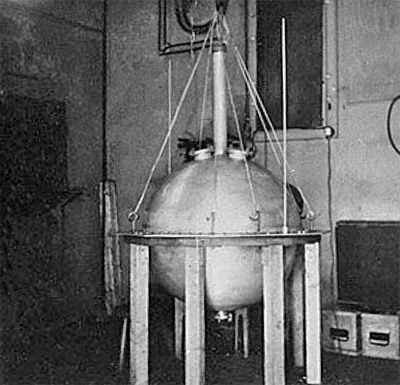
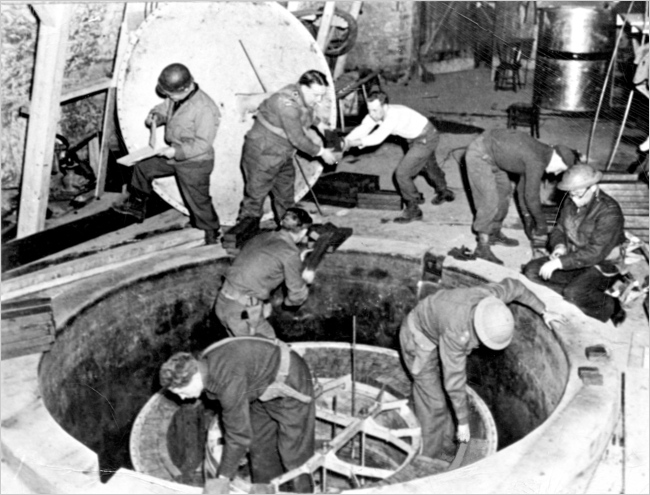
During the project, German scientists agreed to research the feasibility of making a nuclear weapon, including pile design, isotope separation, fast-neutron fission, and other critical aspects of the program.
In addition to uranium research, the German army managed to capture crucial resources during their invasion of Western Europe in 1940, such as ample uranium supplies in Belgium, the cyclotron in France, and the Norsk Hydro power plant in Norway, the largest producer of heavy water, whose chemical properties are suitable for creating the atomic bomb.
However, despite these material advantages, Germany’s ambition to build an atomic weapon was fundamentally flawed due to the systematic disorganization among the German Scientific community, as many had questionable doubts and loyalties about the Nazi regime itself, with some secretly working for Allied intelligence to thwart the program. Moreover, the Nazis’ new National Socialist laws forced many of Germany’s top minds, like Albert Einstein, to flee abroad, reducing the number of experts required in effective research.
Furthermore, German bureaucracy and insufficient coordination also led to many resources being shifted to other priorities, rather than focusing on the development of the atomic bomb. To make matters worse, Allied foreign intelligence managed to gather crucial information on the program through its secret spy network known as the ALSO’s mission, scoring much-needed successes, such as the 1943 Novak hydro power plant sabotage mission by British-trained Norwegian commandos, which disrupted the German capacity to produce large quantities of heavy water.
These factors led to the United States eventually becoming the world’s dominant power in nuclear weapons development through the Manhattan Project, whose two atomic bombs saw action in August 1945 during the bombings of Hiroshima and Nagasaki, Japan.
Still, the concept and rise of nuclear-powered weapons became a significant contributor to tensions during the Cold War and the present day.
https://www.osti.gov/opennet/manhattan-project-history/Events/1942-1945/rivals.htm
https://en.wikipedia.org/wiki/Alsos_Mission
https://en.wikipedia.org/wiki/German_nuclear_program_during_World_War_II

 Military Battle Zone
Leave a comment