One of Britain’s most memorable and formidable weapons of the Second World War, the British supersized “Earthquake” bomb was developed by aviation engineer Barnes Wallis to penetrate heavily fortified targets.
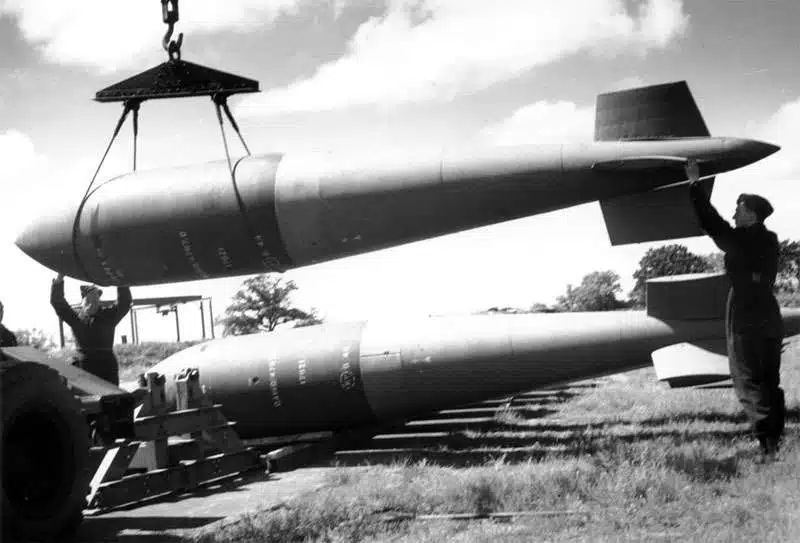
The idea was conceived in 1941 when Barnes wrote a paper advocating for a strategic bombing campaign. For this, he proposed the use of supersized bombs that could penetrate the target and create an earthquake-like pressure wave. Thus, causing the destruction of nearby foundations. At the time, the largest conventional bombs the British Royal Air Force had at their disposal were only 1000 pounds compared to the proposed “earthquake bomb” weighing 12000 pounds. Such a need for producing “earthquake” bombs became more plausible in 1942 when Germany was building reinforced concrete U-boat bases, production assembly areas, and viaducts.
The first “earthquake bomb” produced and used in the war was the Tallboy. Reaching speeds of 750mph and dropping from 45000 feet, each Tallboy bomb was cast in high tensile steel so it could penetrate and detonate deep or below targets without breaking.
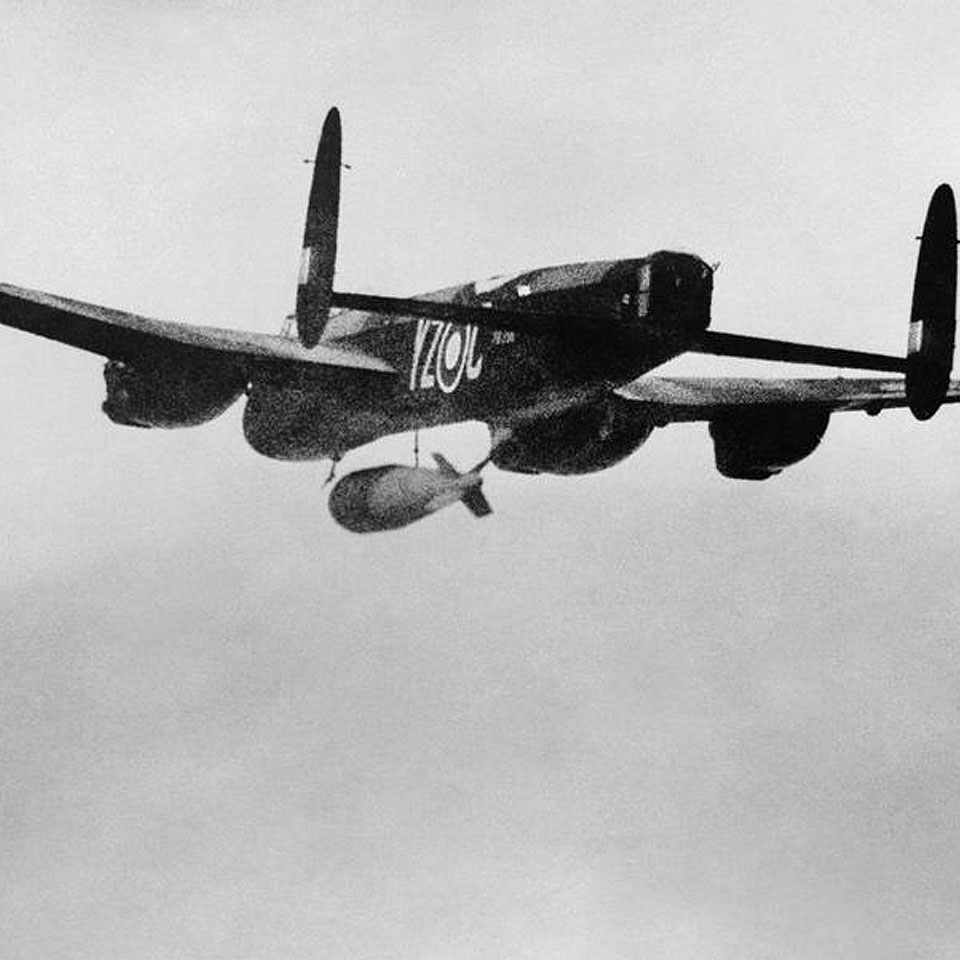
The Tallboy bomb saw action during the various Allied Air campaigns of 1944. For example, the German battleship Tirpitz was sunk by 29 Tallboys carried by modified British Avro Lancaster bombers on 29th November 1944 in Tromso, Northern Norway. By the end of WW2, a total of 854 Tallboys had been dropped, heavily damaging the hardened concrete assembly areas of V2 and V1 rocket launch sites.
Another “earthquake bomb” that was also produced is the “Grand Slam” bomb. A big brother to the Tallboy bomb, weighing 22000 pounds. Like the Tallboy, the Grand Slam was packed with molten torpex, a high explosive of 42 percent cyclonite, 40 percent TNT, and 18 percent powdered aluminum that was 50 percent more than normal TNT explosives, though the bomb was used in the final months of the conflict in 1945.
Still, the development of the British “earthquake bomb” represents a shift in conventional strategies from bombs with explosive force to bombs that require speed and a delayed fuse to cause maximum damage on targets with effective precision. These principles form the basis for the development of more sophisticated weapons seen in the present day, such as the “bunker buster” bombs.
https://www.1stlinedefence.co.uk/news/history-of-the-tallboy-a-12000-lb-wwii-earthquake-bomb/

 Military Battle Zone
Leave a comment