One of the most secret weapons in the Pacific War, the Fu-Go balloon, is part of the Japanese Army’s long-term strategy in response to the US Doolittle raid. Designed to traverse the North Pacific Ocean and carrying explosives and anti-personnel incendiary devices, the balloons were used as a direct reprisal to strike the US mainland.
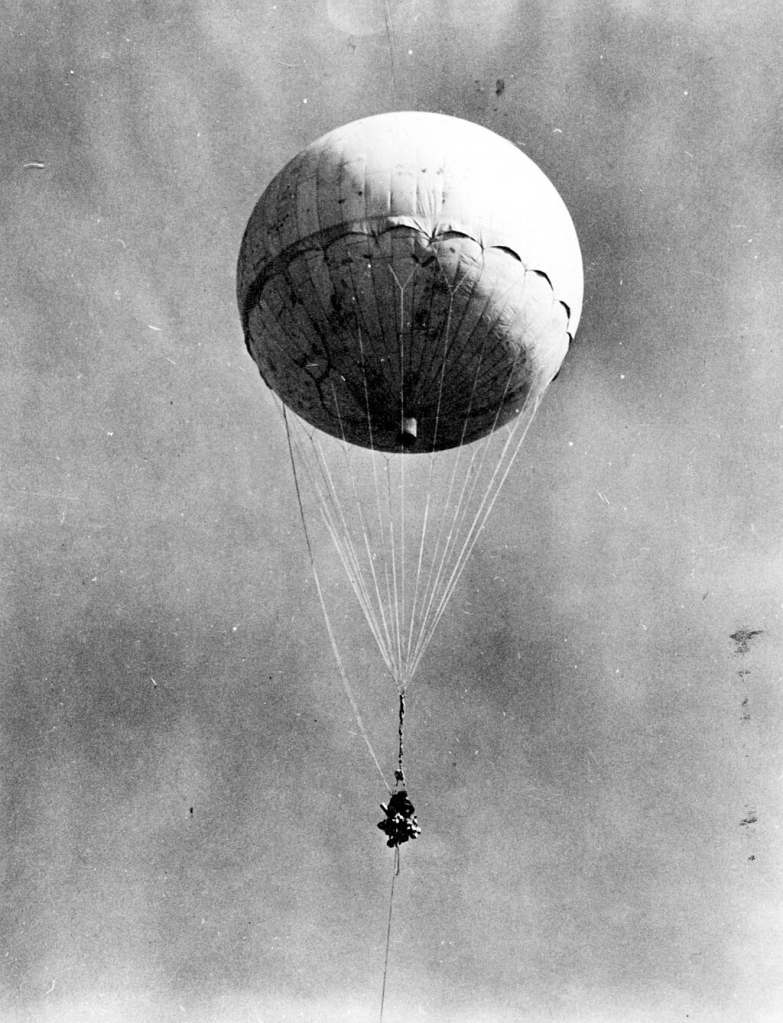
The idea for a balloon bomb was first conceived in 1933 when the Japanese 9th Army’s Technical Research Institute experimented with a short-range balloon bomb. However, a US bomber raid on the Japanese home islands in 1942, also known as the “Doolittle raid”, spurred the Japanese to develop the balloon as a long-range retaliatory weapon. Hence, after intensive research, the result is a prototype hydrogen-filled balloon measuring thirty feet in diameter and made of layers of tissue paper glued together. The prototype carried sandbags as ballasts to regulate the balloon’s attitude during its long journey, a simple radio apparatus to monitor the balloon’s progress and an array of bombs.
In two to three days, the balloons can travel 6200 miles after being released into a jet stream during the winter. From November 3rd, 1944, to early April 1945, 9000 Fu-Go balloon bombs were launched and carried by high-attitude winds eastward across the Pacific to the United States. However, only a few reached their intended targets and caused any damage. For example, one teacher and five children were killed after accidentally detonating the balloon bomb near Lakeview, Oregon, on 5th May 1945, and igniting some short-lived forest fires in Oregon and California. By then, the Japanese had shut down the program due to its limited success in causing any psychological or destructive impact on the United States.
Still, the idea of balloons disguised as an aerial incendiary device shows how innovative the Japanese can be in turning seemingly innocent flying objects into potent killer weapons.
https://www.iwm.org.uk/history/the-terrifying-german-revenge-weapons-of-the-second-world-war
https://www.ebsco.com/research-starters/military-history-and-science/balloon-bombs-japanese

 Military Battle Zone
Leave a comment