The Japanese “shinyo”, which means “sea quake”, are manned explosive motorboats used by Special Attack units of the Imperial Japanese Army and Navy for suicide attacks against Allied shipping during the defence of its territories.
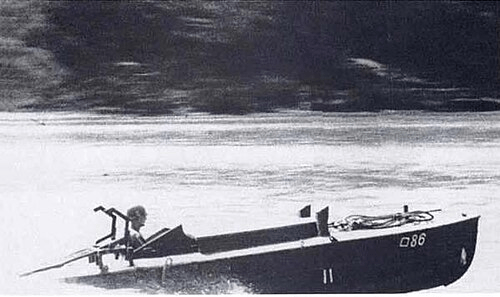
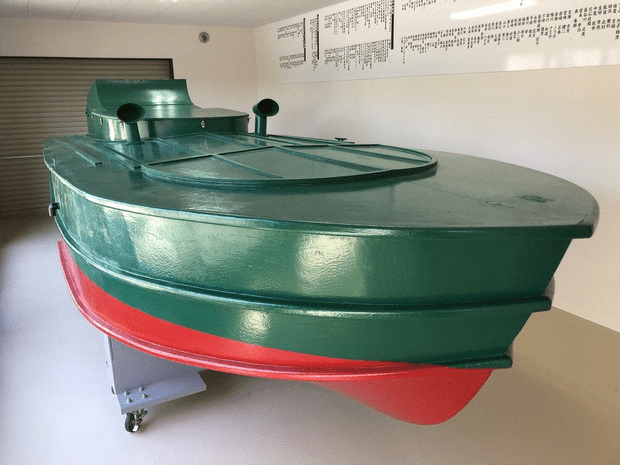
Based on the 18-meter torpedo boats produced in 1941 by Japanese hull designers, the first EMBs (Explosive Motorboats) were constructed in March 1944, comprising a steel-hull design and a wooden-hull design. As Japan was facing a shortage of raw materials at the time it was losing the war, the steel-hull EMBs were abandoned in favour of wooden-hull EMBs.
There were two primary variants of the Shinyo. The one-man Type 1 Shinyo EMBs and the two-man Type 5 Shinyo EMBs. The Type 1 Shinyo EMBs could only reach a top speed of up to 23 knots and dropped off to a dismal 18 knots if carrying a warhead, making it relatively slow. The Type 5, on the other hand, which acts as a command boat and is armed with a 13.2mm machine gun, is slightly larger and faster, reaching a top speed of up to 30 knots powered by two automobile engines. Both Type 1 and Type 5 were equipped with 120mm RO-SA booster rockets to increase the boat’s speed and as makeshift propulsion in case of engine failure.
Over 6197 EMBs were produced by the Japanese Imperial Navy, equipped with a blow explosive charge. The Japanese Imperial Army would also produce their EMBs, which carry two depth charges, though they were not considered suicide boats, unlike the navy’s.
Although the Shinyo scored some successes in disrupting Allied Naval landings during the United States’ invasion of the Philippines and the Japanese home island of Okinawa, its simple and precarious construction made it an easy target for Allied heavy naval guns and roaming P-T boats.
https://www.combinedfleet.com/ShinyoEMB.htm
https://en.wikipedia.org/wiki/Shinyo_%28suicide_motorboat%29

 Military Battle Zone
Leave a comment